Timex has spent the last several years building one of its strongest product franchises around evergreen licensed media properties. This franchise now accounts for roughly one in five products in its portfolio, which is why the stakes were high when the opportunity arose to expand into new licensed partnerships with a major entertainment company.


Timex has spent the last several years building one of its strongest product franchises around evergreen licensed media properties. This franchise now accounts for roughly one in five products in its portfolio, which is why the stakes were high when the opportunity arose to expand into new licensed partnerships with a major entertainment company. The team wasn’t just evaluating a single product launch; they were planning a multi-season roadmap across multiple IP properties, each with its own consumer base, aesthetic language, and commercial potential.
"When you're moving into multi-year deals," says Shawn Lawson, SVP of Innovation, Growth Initiatives and Mass Market Strategy at Timex, "it's much better to be in a position to have clear direction and confirmation that you're going in the right direction."
Making it more challenging: the retail environment had changed. "You don't have as much time in market to launch and refine," Lawson notes. Getting it right from the start — not through test and learn — was the only viable path.
Without research, Timex would have relied on instinct. The team had strong hypotheses about which properties to pursue, but intuition alone couldn't answer the harder questions: which specific designs should anchor a launch? Which characters resonate beyond their consumer base? How do new properties benchmark against a commercially proven line?
"The ability to benchmark, layer, and connect findings across studies — rather than treating each one in isolation — is what turned research into a confident roadmap."
Shawn Lawson
SVP of Innovation, Growth Initiatives & Mass Market Strategy, Timex
Insights teams in food & beverage are under more pressure than ever. More decisions, faster timelines, fewer resources. Here’s where we help most.
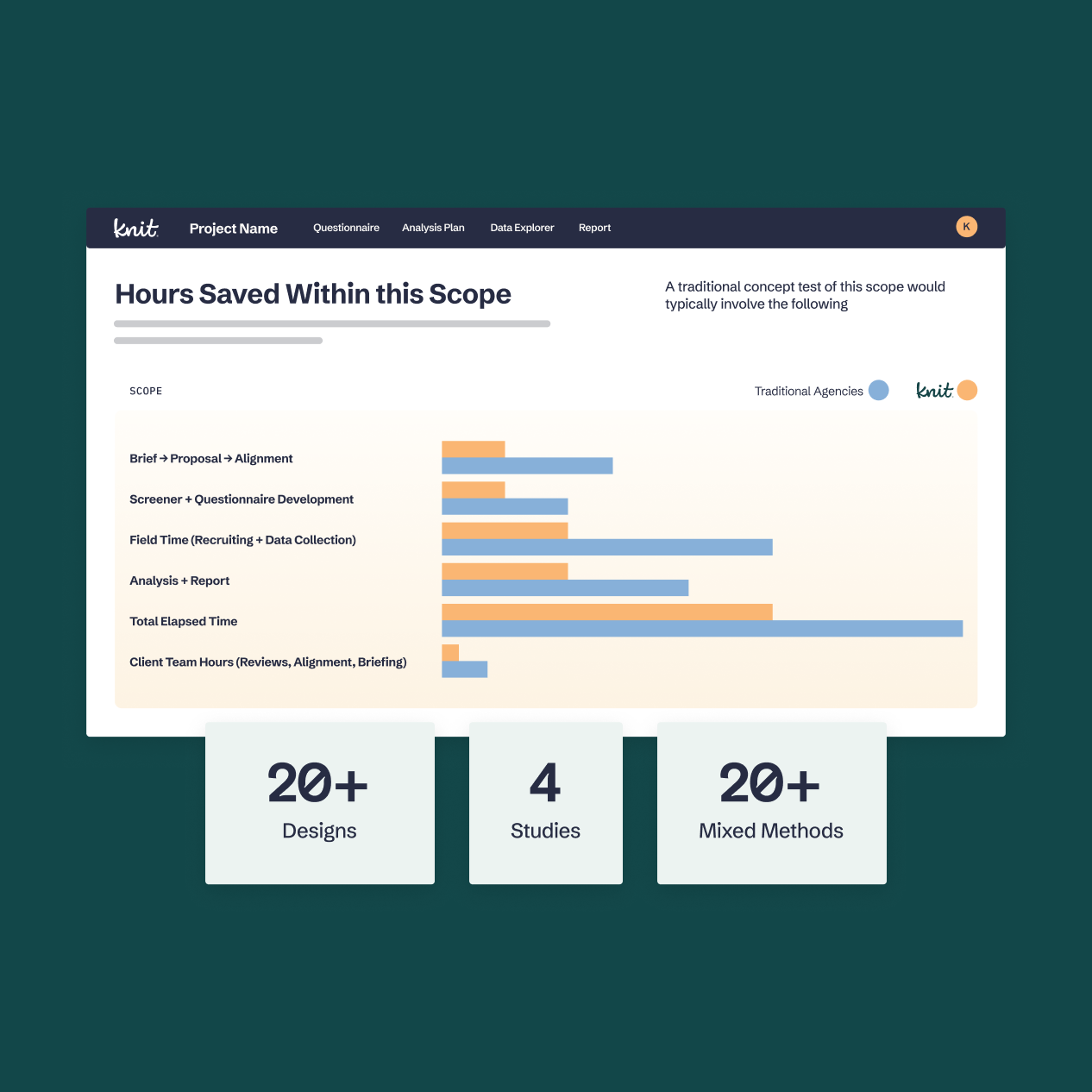
Traditional research of this scope — setting objectives, building a screener, fielding a survey, analyzing results — would have taken the better part of a quarter. Knit completed both phases in six weeks. "The fact that you're able to truncate the timeline to six weeks — that's the game changer," Lawson says. Critically, that speed wasn't just an operational win. It meant findings arrived in time to shape the decisions they were meant to impact future product development, not after commitments had already been made.
The research didn't just answer "which property,” it built an ordered launch sequence. Timex entered the work with more than 20 designs across multiple price points and IP properties. The findings surfaced which designs resonated most with core consumer segments, which to build toward in subsequent seasons, and which to cut before production commitments were made. "Being able to launch with those core styles that resonate the most with your consumer base is a great way to launch a product portfolio, and then you can build out from there."
Some of those findings contradicted the team's first instincts. "Intuitively, we thought [one property] was definitely the way to go," Lawson says. The data refined that view and protected against the cost of leading with the wrong designs at scale. For a licensed watch line, a typical retail buyer order can represent 500–2,000 units per SKU. Getting the launch slate right isn't a subjective call; it's an inventory and retailer relationship decision with real downstream consequences.
A study of this scope would typically require 50–60 hours of client-side involvement across briefing, reviews, and alignment. Working with Knit, that dropped to roughly 20 hours — a two-thirds reduction. For a lean team already running at capacity, that's not a footnote. It's the difference between research that's possible and research that doesn't happen at all.
Most concept testing informs a single launch decision. This body of work — four studies, a clear benchmark, and two phases of layered findings — is built to inform multiple seasons of product decisions. "We could take the information and make the change in real time," Lawson notes. "It allows you to optimize." The benchmark data in particular creates a permanent reference point: as Timex evaluates future properties, they now have a proven line to measure against rather than starting each new study from zero.
The consumer data didn't stay in a research report. It became a tool for internal alignment and for walking into internal sales presentations and retailer conversations with independent verification. "Of course, we always think the latest season is the best season," Lawson says. "But it's nice to have that independent verification." Across four internal teams — Brand, Marketing, Product, and E-Commerce — the findings were translated into the language each stakeholder needed to act on them.
studies across two phases, 6 weeks, and 20+ concepts evaluated
tested to 1 hero SKUs and 8 supporting SKUs selected for launch — with a clear pipeline for seasons to come.
of client team time vs. 60 at a traditional agency; or 3x more efficient on client time
"Everyone is trying to do more with less. Having a trusted research partner who could run with this, keep it moving, and translate insights into the language of our different stakeholders — it was incredibly valuable."
Shawn Lawson
SVP of Innovation, Growth Initiatives & Mass Market Strategy, Timex
For Timex, the value wasn't just the speed or the AI; it was having a research partner who understood the business context well enough to connect the work across studies, translate findings into the language of each internal stakeholder, and proactively suggest directions the team hadn't thought to ask for.
"Everyone is trying to do more with less," Lawson says. "You really need additional support at the partner level when you're executing this research, because unfortunately, we don't have large research [teams]."
The result was a body of research that didn't sit on a shelf. It shaped which products launched, in what order, and with what positioning, giving the Timex team the confidence to move decisively in a faster-moving retail environment.
From individual brand strategy projects to ongoing concept testing studies, the world’s best brands are scaling their insights with efficiency and ease through Knit.

Check out Knit’s Researcher-Driven AI Platform in action.
Submit the form. Grab some time. Let’s chat!