

Every insights team is under similar pressure right now. Stakeholders want them to deliver richer consumer understanding in less time with the same (or even smaller) budget. AI makes this possible — theoretically, anyway. It’s flooded the market with tools that promise rapid answers and deliver shallow ones. According to Knit’s AI Trust Index, a survey of 150 research professionals, insights teams spend an average of X reworking AI outputs.
The truth is that AI-powered consumer insights are only as good as the research design behind them. AI can write a questionnaire in seconds, but it can’t tell you whether that survey asks the right questions of the right people in the right way. Does it adhere to proper methodologies according to stakeholders’ key business priorities? Is there potential to inadvertently sway participants to respond a certain way, leading to dangerous confirmation bias? This part still requires research expertise.
The brands reaping the greatest value from AI aren’t the ones that bought the fastest tool; they’re the ones that invested in AI without sacrificing methodological rigor.
This guide will walk you through what AI-powered consumer insights really are, how AI changes each stage of the research process, and what to look for in a partner if you’ve found DIY tools lacking.
What Are AI-Powered Consumer Insights?
AI-powered consumer insights are findings about consumer attitudes, motiva, preferences, and behavior that artificial intelligence generates, accelerates, or enhances at one or more stages of the research process (from study design and fielding to moderation, analysis, and reporting).
This definition is deliberately broad because AI can influence each stage in different ways. In quantitative research, AI speeds up aspects like survey programming, sample matching, and statistical analysis. In qualitative research, AI-moderated interviews can “converse” with hundreds of participants simultaneously, probing individual responses in a way human moderators can’t scale. On the analysis side, AI can synthesize thousands of open-ended responses, video transcripts, and survey cross-tabs into themes in hours instead of weeks.
What AI doesn’t change, however, is the judgment required to design valuable research. AI is a tool, not a replacement for human expertise. AI can execute a poorly designed study and produce confident, well-formatted, but ultimately flawed answers. The insights teams that understand this difference (or better yet, the stakeholders) don’t just ask which AI tool to buy; they ask, “How do we combine AI capabilities with research expertise?”
How AI Changes the Consumer Research Process
Let’s examine how AI influences the research lifecycle stage by stage:
Scoping
This is the stage where most bad research is born. The right methodology depends on the business question: is this a concept test, a positioning study, a segmentation, an attitudes and usage refresh, or something else? AI can accelerate scoping when experienced researchers who know which method is most appropriate for which decision guide it. At Knit, for example, research scoping starts with your business objective and works backward to design. AI handles the heavy lifting of drafting and iteration while researchers make the methodological calls.
Survey Design
AI can draft questionnaires, generate probing follow-ups, and flag leading or double-barreled questions in minutes (but someone still needs to know whether the question structure will produce decision-grade data). AI-assisted design under expert supervision gets you both speed and validity.
Fielding
This stage is where AI affects the economics of qualitative research most dramatically. Traditional focus groups can cap at 6-10 participants per session, scheduled over weeks. AI-moderated research lets you field to hundreds of participants at once, each getting an adaptive, personalized interview experience.
Analysis
AI can transcribe, code, and synthesize thousands of open-ended text and video responses, surface themes, and quantify sentiment across full samples. Of course, analysis is where data interpretation comes in: what narrative do the findings tell? How can you examine the data from a new lens? AI-powered analysis that pairs computational scale with professional judgment delivers insights you can actually act on (because a theme count is not the same as an insight).
Reporting
AI accelerates creating deliverables, such as one-pagers and final decks. When driven by researchers familiar with a particular category and business context, reports are producible much faster than humans alone and require much less rework than AI alone.
The pattern is the same across all five stages: AI handles scale and speed while humans handle jdgement. You can see how this plays out across Knit’s full research capabilities.
AI-Moderated Qualitative Research: What It Is and Why It Matters
AI-qualitative research uses AI probing to conduct conversations, most commonly interviews, at scale (usually in the form of text instead of an AI-generated character asking verbal questions). Participants respond on camera and to follow-ups while the AI adapts in real time: it asks why, requests examples, and digs into the specifics of what an individual just said.
The common objection is that AI-moderated research lacks the depth of a human-moderated IDI or focus group. It’s a fair concern — one our CEO has addressed over at MRII — but we want to answer it here directly as well.
A traditional focus group gives you a handful of people with one moderator for a couple of hours. An AI-moderated video study, however, can collect responses from dozens or even hundreds of participants, each with a personalized interview that probes their respective answers. You lose the group dynamic or a human moderator’s ability to diverge from a discussion guide as necessary to get to the bottom of a certain response or behavioral cue, but you eliminate groupthink and benefit from respondents’ tendencies to treat AI like a diary (they’re often more candid than when speaking to a person).
AI-moderated interviews are not a replacement for IDIs or focus groups; they’re merely another tool to use alongside them or in other appropriate use cases. For many business objectives, like concept and package testing to journey mapping, the scale is worth the depth sacrifices. For others, like co-creation sessions, human moderation is still practical.
Knit's AI-moderated video questions combine the scale of AI moderation with human review of the interview design and output, so you get the speed without surrendering the methodology. And because every session is on video and fully transcribed, stakeholders can hear consumers say it in their own words, which is often what actually moves a decision forward.
Quant-Qual Integration: Getting Both Breadth and Depth
Most research agencies or platforms make customers choose between quant and qual. Survey tools give you the breadth of statistically projectable numbers, but the data lacks color and texture. Qual platforms give you depth: rich stories, but from sample sizes too small to be more than anecdotal. Reconciling the two traditionally means running two studies, two vendors, two timelines, and a manual synthesis exercise in the middle.
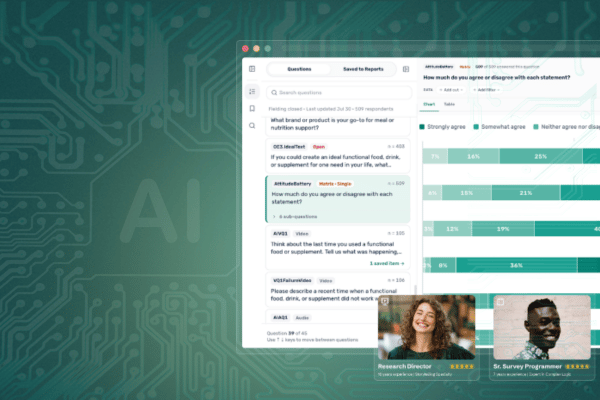
Agencies like Knit, however, can run both quant and qual in a single engagement. A typical Knit study pairs a quant survey with AI-moderated video responses embedded in the same study, so participants answer scaled questions for the numbers, then talk through their reasoning on camera for the why. For example, let’s say a survey tells you that 62% of your target audience prefers concept B. It’s good to know which concept performed better, but the video layer gives you context, in respondents’ own words, at a sample size you can actually segment.
This matters because the most expensive insights failures aren’t always wrong numbers; they’re correct numbers with misinformed interpretations. Quant without qual tells you what changed, but not why, so teams act on correlation. Qual without quant tells you a vivid story from a handful of people and leaves you hoping the generalization is accurate enough to base decisions on. Integrating them in one study, one sample, and one analysis framework closes that gap, resulting in the difference between a platform that generates data and a partner that provides genuine insights.
What to Look for in an AI-Powered Consumer Insights Partner
If you’re evaluating AI research tools or partners, here’s a useful checklist that will help keep you from falling for shiny objects:
Methodology transparency: Can the vendor explain why it’s designing the study the way it is, and what the AI is doing (and not doing) at each stage? A partner who can’t defend their methodology is selling you a demo, not research.
Sample quality: AI can’t fix a bad sample; it just produces bad insights faster. Ask where participants come from, how the vendor approaches data quality, how it controls fraud, and how it verifies representativeness.
Analysis depth: Does the output include a researcher interpretation, or just auto-generated summaries and word clouds? Ask to see a full deliverable from a comparable study (within legal reason), not a highlight reel.
Turnaround time: Speed is table stakes nowadays, but it only matters if the research is valid. A credible partner can use AI-moderated methods to cut traditionally months-long processes to weeks or even days, but be sure you’re confident in the workflow first.
Deliverable format: Will you get a deck you can take to your leadership team, video clips that make participants tangible, or a researcher who can defend the findings? Or a dashboard login and login alone?
Ask any vendor about these five items. Pure self-serve SaaS tools tend to fail on the first and third: there’s no methodology owner or researcher driving and interpreting the output. This gap is exactly why Knit believes in augmenting professionals with AI rather than replacing them. You get the AI speed, but you also get someone accountable for conducting a study that’s actually good.
Real-World Applications: Industries and Use Cases
The pattern holds across sectors, with different questions at the center.
CPG. Concept testing, packaging claims, and innovation pipelines where speed to shelf matters. AI-powered research lets CPG teams test more concepts with real consumers before committing development dollars. See Knit's work in CPG, including our Mars case study on scaling consumer feedback across a global innovation portfolio.
Media and entertainment. Content testing, fan engagement, and audience development, where passionate sub-audiences behave very differently. Our NASCAR work used AI-moderated video to understand what drives fan loyalty across generations. More in media.
Retail. Shopper journey, assortment, and omnichannel experience questions where stated preference and actual behavior diverge. JBL's retail experience research is a good example of pairing survey breadth with video depth. Details in retail.
Food and beverage. Taste, occasion, and wellness positioning, where the "why" behind purchase intent is everything. Overtime's work with Knit on better-for-you snacking for teen athletes shows how video responses reveal motivations a checkbox survey misses. Read more about food and beverage.
Tech. Product-market fit, feature prioritization, and messaging tests on compressed timelines, where AI-moderated research turns a quarter-long study into a two-week sprint. Find out more in tech.
In each case the value came from the same combination: AI handling scale, researchers handling design and interpretation.




Get the latest research insights and product updates from Knit straight to your inbox.


