Webinar
The Modern Value Equation Has Changed. Here's What the Data Shows.
New research from McCormick and Knit reveals why brands optimizing for price alone may be solving for the wrong problem.
August 13, 2026
Online event
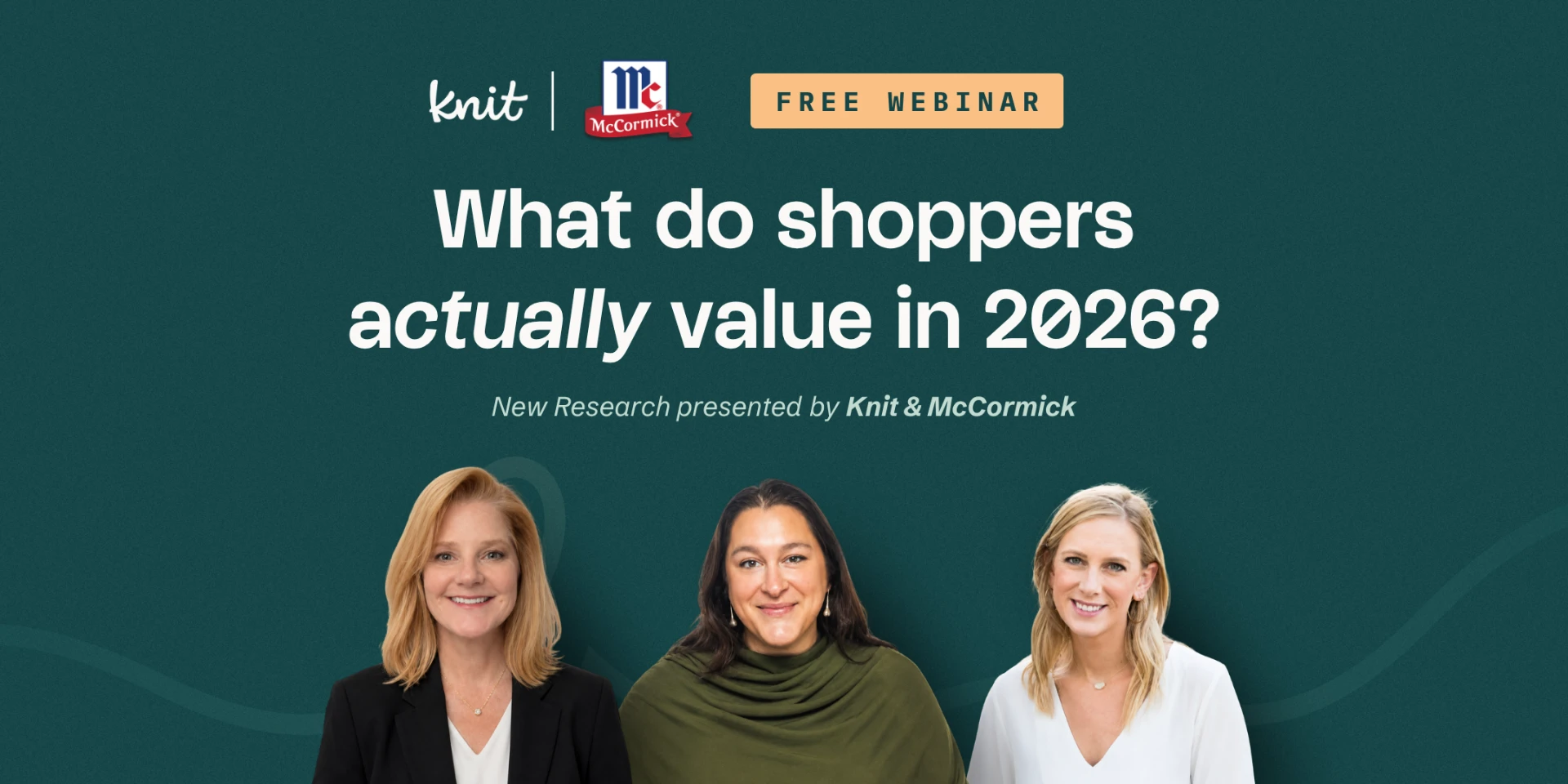

New research from McCormick and Knit reveals why brands optimizing for price alone may be solving for the wrong problem.
August 13, 2026
Online event
Ask most CPG marketers what drives shopper choice, and the answer is usually some version of the same story: consumers are price-sensitive, private label is growing, and the brand's job is to justify a premium. It's a framework that's been reinforced by a decade of economic pressure and category data. It's also, according to new research, only part of the picture.
Knit, the AI-Native Research Agency, recently completed a proprietary study in partnership with McCormick that set out to understand exactly how today's shoppers define and experience value. The results are nuanced, surprising in places, and — if you're a brand marketer — genuinely worth your attention.
The research reveals that when shoppers talk about value, they're describing something richer and more contextual than a price tag. The word shows up in their language as a feeling of confidence, of control, and of making a smart choice. And what generates that feeling varies considerably depending on the category, the occasion, and the shopper's own circumstances.
This isn't just a philosophical observation. It has direct implications for how brands communicate, where they invest in the path to purchase, and which competitive threats they actually need to worry about.
One of the most actionable findings in the research concerns what we call the stakes-based model of brand loyalty. Shoppers, it turns out, are not uniformly resistant or flexible when it comes to switching to cheaper alternatives. Their behavior is highly category-specific — and the key variable isn't how much they like the brand. It's how much they can afford to be wrong.
In categories where a bad choice is low-cost and easy to recover from, shoppers exhibit significant flexibility. In categories where failure is costly — whether that's in terms of wasted food, family pushback, health concerns, or emotional investment — they protect their choices with remarkable consistency, even under budget pressure.
For brand managers, this reframes the loyalty conversation entirely. The question isn't just “how do we build brand love?” It's “what is the perceived cost of a bad choice in our category, and how do we make that cost legible to shoppers?”
Perhaps the most significant structural finding is what the research reveals about multi-channel behavior. The modern shopper isn't choosing a single retailer and optimizing within it. They're actively constructing a value equation across channels, retailers, and shopping modes — trading off price, quality, convenience, and control depending on what matters most in a given moment.
This has profound implications for how brands think about their retail strategy, their promotional investments, and how they show up in the moments that matter most. A shopper who splits their trip to get the best quality or selection on specific categories is not a loyalty problem. They're telling you exactly what they value — if you're listening.
On August 13, Dorothy White from McCormick and Liz Miller and Kelly Stanislaw from Knit will walk through the full study findings in a free, one-hour webinar. You'll get access to the quantitative data, the qualitative video insights, and the strategic implications — plus the opportunity to ask questions live.
This is not a product pitch. It's a research presentation: the kind of work that typically costs six figures to commission and stays locked inside a brand's internal reports. We're sharing it because we think the industry needs this conversation.